
Heat Pump for a Victorian Terrace: What You Need to Know Before Installing
Victorian terrace owners face unique heat pump challenges. Solid walls, tight spaces and heritage rules don't have to stop you. Here's how to get it right.

Written by Heat Pump Buddy
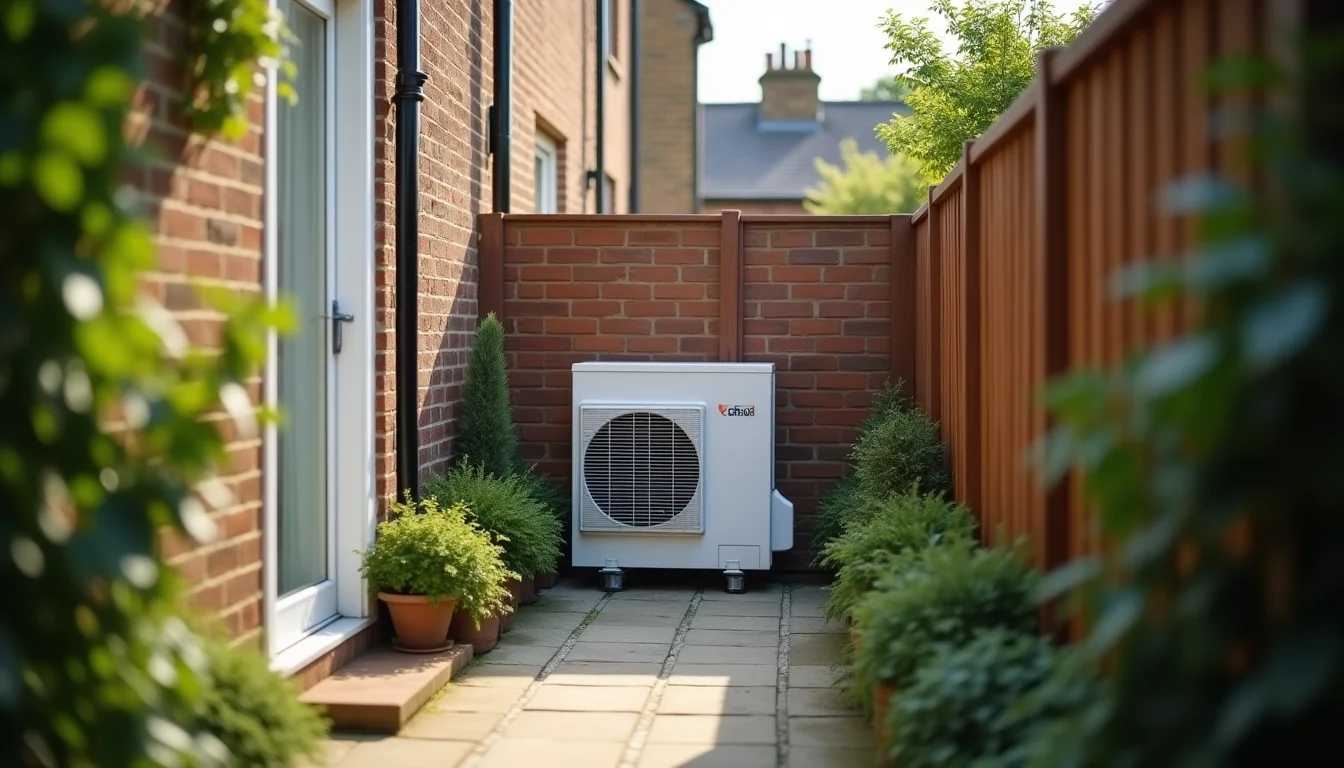
Yes, you can install a heat pump for a Victorian terrace, but it takes more planning than a modern detached house. The main hurdles are solid walls with poor insulation, limited outdoor space for the unit, and potential conservation area restrictions. Get these right, and a heat pump can heat a Victorian terrace effectively while slashing your gas bills and carbon footprint.
Why Are Victorian Terraces Trickier for Heat Pumps?
Victorian terraces were built between roughly 1837 and 1901, and almost all of them have solid brick walls. That matters because solid walls lose heat about twice as fast as cavity walls. A modern detached house might have a heat loss of 5-7 kW, while a mid-terrace Victorian property of similar size can hit 8-12 kW without insulation upgrades.
The other issue is space. Most Victorian terraces have a small yard or patio rather than a large garden, and the front opens straight onto the pavement. An air source heat pump unit needs somewhere to sit with adequate airflow, and it needs to comply with permitted development rules on distance from boundaries.
Then there's noise. Permitted development rules state the unit must not exceed 42 dB at your nearest neighbour's window. In a terrace, your neighbour's window might be three metres away. That limits your choice of unit, though several manufacturers now produce models that run well below 40 dB.
Do You Need to Insulate a Victorian Terrace Before Fitting a Heat Pump?
Honestly, you don't always need to do everything before you install. But some insulation work makes a real difference to both comfort and running costs.
The biggest win is usually internal wall insulation or external wall insulation. Internal wall insulation (IWI) adds about 60-100mm of insulated board to your interior walls and can cut heat loss through those walls by up to 70%. It does reduce room sizes slightly, which in a narrow Victorian terrace feels noticeable. External wall insulation (EWI) avoids that problem but changes the look of the building, which won't fly in conservation areas.
Loft insulation is cheap and effective. If you've got less than 270mm up there, topping it up costs a few hundred pounds and makes a measurable difference. Draught-proofing original sash windows is another quick win that doesn't require replacing them.
A good MCS certified installer will carry out a proper heat loss calculation before recommending a system. If your heat loss is too high, they'll tell you what insulation to prioritise before the install goes ahead. Don't skip this step.
Where Does the Heat Pump Actually Go on a Victorian Terrace?
This is the question that worries most terrace owners, and rightly so. You need a spot that allows good airflow around the unit, meets planning distance rules, and doesn't create a noise problem for neighbours.
For a mid-terrace, the back yard is usually the only option. The unit needs at least 300mm clearance from the wall behind it and ideally a metre or more of open space in front for airflow. Corner spots in small yards can work, but the installer needs to check that reflected sound off surrounding walls won't push noise levels above the 42 dB limit.
End-of-terrace properties have more flexibility. A side passage or side return can work well, provided there's enough clearance. Some homeowners have mounted compact units on brackets on the rear wall to free up ground space, which is worth discussing with your installer.
Let's look at a real example. A couple in South London had a two-bed mid-terrace Victorian with a yard measuring just 3m x 4m. Their installer fitted a Vaillant Aroetherm Plus 5kW unit in the corner of the yard on anti-vibration feet, with acoustic fencing on two sides. The unit runs at 38 dB, well within limits, and they kept enough yard space for a small table and chairs.
What About Listed Buildings and Conservation Areas?
If your Victorian terrace is in a conservation area or is Grade II listed, you'll face extra planning requirements. But this doesn't mean a heat pump is off the table.
For conservation areas, permitted development rights for air source heat pumps still apply in most cases, as long as the unit isn't visible from a highway and meets noise limits. If it is visible, you'll need to apply for planning permission. Many councils are now more receptive to heat pump applications than they were a few years ago, particularly as government decarbonisation targets tighten.
Listed buildings always require listed building consent for a heat pump installation. Your local conservation officer will want to see that the installation won't harm the character of the building. Placing the unit in a rear yard, away from the principal elevation, and running pipework through existing openings rather than drilling new holes through original brickwork will strengthen your application.
Frankly, the planning side takes patience. Budget an extra 8-12 weeks for the consent process if your property is listed.
How to Claim the £7,500 BUS Grant for a Victorian Terrace Heat Pump
The Boiler Upgrade Scheme (BUS) grant is still available in 2026 and provides £7,500 towards the cost of an air source heat pump. It applies to Victorian terraces just as it does to any other property type, provided you meet the eligibility criteria.
Here's what you need:
- Your property must have a valid EPC (Energy Performance Certificate). It doesn't need to be a specific rating, but you do need one.
- You must be replacing a fossil fuel heating system, typically a gas or oil boiler.
- The installation must be carried out by an MCS certified installer who applies for the grant on your behalf.
- Your property must have an existing loft insulation level of at least 125mm (or equivalent), though your installer can advise on this.
The grant is applied at the point of installation, so you don't pay the full price and claim back later. A typical air source heat pump installation for a Victorian terrace costs between £10,000 and £15,000 depending on the size of the system, radiator upgrades, and any pipework changes. With the £7,500 grant, you're looking at an out-of-pocket cost of roughly £2,500 to £7,500.
Don't assume your installer will automatically apply. Ask them upfront whether they handle BUS grant applications and check they're MCS certified before you commit.
"Will a Heat Pump Actually Keep My Victorian Terrace Warm Enough?"
This is the number one concern, and it's completely fair. Victorian terraces can be draughty, and the idea of replacing a gas boiler with something unfamiliar feels risky.
Here's the truth: a properly sized heat pump, installed by someone who knows what they're doing, will keep your house warm. The key word is "properly sized." A heat pump works best when it runs steadily at a low flow temperature, typically 35-45°C compared to a gas boiler's 60-75°C. That means you may need larger radiators in some rooms, or you might benefit from underfloor heating on the ground floor if you're already doing renovation work.
The worry about cold snaps is understandable. Modern air source heat pumps operate efficiently down to -15°C or even -20°C. The UK rarely drops below -5°C for sustained periods. Your heat pump won't struggle.
What does matter is getting the heat loss calculation right. If your installer just guesses, you'll end up with a system that's too small or too large. Both are problems. Insist on a room-by-room heat loss survey before any equipment is ordered.
And here's something people overlook: because a heat pump runs at a lower temperature, your home stays at a more consistent warmth rather than the hot-then-cold cycling of a gas boiler. Most people who make the switch say their house feels more comfortable, not less.
Frequently Asked Questions
Can you put a heat pump on a Victorian terrace?
Yes. Air source heat pumps are suitable for Victorian terraces, though you'll need to plan carefully around solid wall insulation, outdoor space for the unit, and potential noise considerations with close neighbours. An MCS certified installer can assess your specific property.
How much does a heat pump cost for a terraced house in 2026?
A typical air source heat pump installation for a terraced house costs between £10,000 and £15,000 before the BUS grant. After the £7,500 grant, most homeowners pay between £2,500 and £7,500 out of pocket, depending on system size and any radiator upgrades needed.
Do Victorian houses need insulation before a heat pump?
Some insulation improvements are usually recommended, particularly loft insulation and draught-proofing. Solid wall insulation makes the biggest difference but isn't always essential if the heat pump is correctly sized. Your installer should carry out a heat loss assessment to advise what's needed.
Can I get a heat pump if I live in a conservation area?
In most cases, yes. Permitted development rights for air source heat pumps apply in conservation areas as long as the unit isn't visible from a highway. If it is visible, you'll need planning permission. Listed buildings always require listed building consent.
Are heat pumps too noisy for terraced houses?
Modern air source heat pumps run at 35-42 dB, which is roughly the volume of a quiet library. Permitted development rules require the unit to stay below 42 dB at the nearest neighbour's property. Many current models come in well under this limit, and acoustic measures can reduce noise further.
If you're ready to explore whether a heat pump makes sense for your Victorian terrace, start by getting quotes from MCS certified installers in your area. You can find vetted local installers on heatpumpinstallerdirectory.co.uk and compare options with confidence. Every installer listed is MCS certified and qualified to apply for the £7,500 BUS grant on your behalf.